
The 2026 Operational Risk Horizon brings together insights from 47 leading banks, insurers and asset managers worldwide to assess how the risk landscape is evolving and where firms see the greatest emerging pressure.
In this annual study, firms rank 11 emerging risk categories and assess six macroenvironmental themes, identifying the concerns, drivers and mitigation actions shaping the next 12 to 36 months. This blog highlights selected headline findings from this year’s study.
Headline findings: A risk horizon that’s closer, faster and more interconnected
Firms are operating in an environment defined by uncertainty, accelerating change and increasing interdependence across risk types. The 2026 study reinforces three persistent industry challenges:
- Uncertainty dominates: Geopolitical shifts, economic volatility and technology-driven disruption are rapidly altering risk profiles.
- Interconnectivity is reshaping analysis: Risks cannot be viewed in isolation, particularly where technology, geopolitics, supply chains and data overlap.
- The need for resilience is greater than ever: Firms highlight the importance of agility, strong data governance and clear enterprise awareness of vulnerabilities.
This year, many firms are increasingly focusing on shorter-term horizons (6–12 months) for the highest‑ranked risks, while trying not to lose sight of longer-term developments.
47
institutions taking part in the survey

11
emerging risk categories

6
key themes
The top five emerging risk categories for 2026
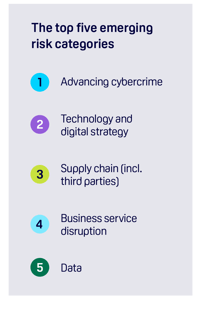 The top five risks remain dominated by digital and resilience pressures, shaped heavily by the rapid advancement of AI and evolving geopolitical dynamics.
1. Advancing cybercrime
Still one of the top-ranked threats. The malicious use of AI, rising sophistication of attacks and continued third-party vulnerabilities keep cybercrime at the centre of concern.
2. Technology & digital strategy
A fast-evolving digital landscape brings opportunities, but also governance challenges, technical debt, AI-related uncertainty and pressure to modernise responsibly.
3. Supply chain (including third parties)
Highly interconnected supply chains increase exposure to disruption, concentration risk and regulatory scrutiny, especially where critical services rely on a small number of global providers.
4. Business service disruption
Firms are grappling with increasing dependency on technology, third parties and cloud infrastructure. Low tolerance for downtime and fast-moving incidents amplify the challenge.
5. Data
Data remains both a strategic asset and a rising source of operational exposure. Firms highlight ongoing concerns around data quality, governance, storage, leakage and the implications of AI-driven models.
Themes reshaping 2026: What’s influencing the industry now
Advancing cybercrime
Remains the top ranked emerging risk category; a rapidly evolving threat landscape and high connection with other risk areas
Geopolitics
Still a prominent theme across the emerging risk landscape
Technology and digital strategy
High in the ranking, with AI and quantum computing accelerating concerns
Skills, culture and wellbeing
Longer term concerns
Data
An asset to protect and a valuable resource for strategic, timely decision-making
Regulation
A high regulatory burden and continued regional divergences
How firms are responding to a shifting risk landscape
- Expanding simulation exercises (e.g. scenarios), with many using ORX Scenarios to stress test resilience against severe but plausible events
- Reviewing action plans for their most material concerns, comparing for adequacy against risk profile
- Reviewing supplier contingency plans as supply chain vulnerabilities grow
- Exploring interconnectivity reporting methods for a more holistic approach to
interconnected challenges - Improving data structure and hygiene to support secure AI usage and decision-making
- Collaborating with industry peers and regulators to share best practices and knowledge on current challenges, such as evolving cybercrime and fraud methods, including through services like ORX Cyber.
- Holding more regular SME engagements on fast-moving topics like cybercrime and fraud
- Evaluating recruitment and upskilling strategies for adequacy against future needs
Curious about further risk management actions?
The Operational Risk Horizon 2026 free executive summary provides a focused overview of this year’s most significant shifts, highlighting how 47 leading financial institutions are prioritising emerging risks and responding to a more compressed and interconnected risk landscape.
The full Operational Risk Horizon 2026 report, available to ORX Members and ORX Lite subscribers, includes detailed benchmarking, ranking scores and practical risk management actions drawn directly from participating firms.