
CRR3 one year on: Early system-level signals from EU operational risk RWAs
This blog builds on our June 2025 blog, How will CRR3 reshape Pillar 1 capital in the EU?, which explored the implications of the Standardised Measurement Approach (SMA) following early indications of a significant increase in operational risk RWAs within European firms after CRR3 came into force on 1st Jan 2025.
A year on from the implementation of CRR3 in the EU, newly available system-level supervisory data provides a broader perspective on our 2025 observations. Evidence from the European Banking Authority (EBA) indicates that operational risk Risk-Weighted Assets (RWAs) contribute a larger proportion of total RWAs across EU/EEA banks than before the implementation of CRR3. This blog revisits the questions raised in 2025 and considers what it suggests about the evolving capital mix under Basel IV rules.
From early firm evidence to system-level signals
The June 2025 blog drew on reporting from Risk.net, which revealed BNP’s 60% increase in operational risk RWAs. This provided early firm-level evidence of how the shift away from internal models such as the Advanced Measurement Approach (AMA) and the Standardised Approach (TSA) towards the SMA might affect Pillar 1 requirements. It also noted the uncertainty created by divergent implementation timelines across jurisdictions and by national discretions such as the treatment of the Internal Loss Multiplier (ILM). At the time, it remained unclear whether these observations reflected isolated firm-specific effects or signalled a broader structural change resulting from replacing AMA and TSA with the SMA in Pillar 1.
Newly-available EBA supervisory data shows a change in the composition of total RWAs following the implementation of CRR3. Up to 2024, operational risk consistently accounted for around 10% of total RWAs across EU/EEA banks. In the first three quarters of 2025, this share rises to approximately 13%, marking a clear step change that coincides with CRR3 coming into force.
The chart below illustrates this shift in the RWA mix over time. It suggests a structural reweighting of the RWA mix, with operational risk taking on a larger role alongside credit and market risk.
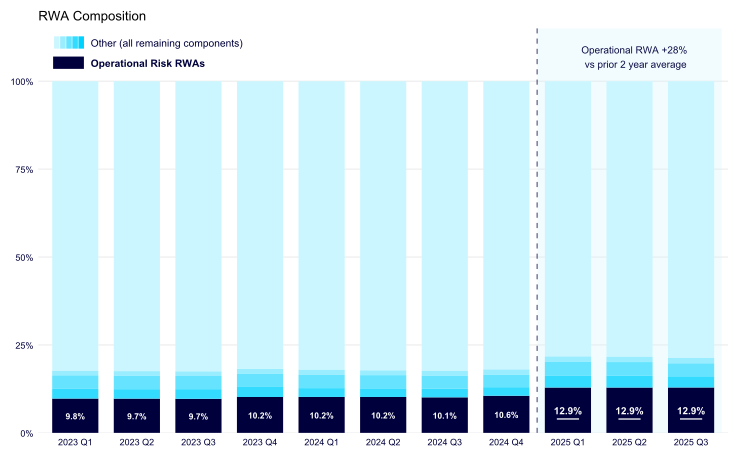
Using data from (Feb 2026 EBA Risk Dashboard – Own Funds and Risk Weighted Assets)
The observed shift in system-level operational risk RWAs increases as CRR3 is implemented aligns with the SMA's structure. Under the SMA, operational risk capital depends mainly on bank scale via the Business Indicator (BI) with internal losses having no effect when ILM = 1.
This pattern also aligns with earlier Basel IV monitoring results and with the ORX Capital Benchmark studies. Our benchmark studies show that under QIS style submissions and regulatory discretion, such as setting the Internal Loss Multiplier (ILM) to 1, operational risk capital tends to increase relative to previous frameworks with a particular large increase for the largest banks (those with asset size greater than €750bn).
Where the EBA Basel III Monitoring report expected an increase of approximately 28%, the ORX Capital Benchmark shows a similar increase of around 27% for European-based participating firms.
The realised EU/EEA increase in operational risk RWA closely matches the EBA’s expectations as shown in the table below.
Changes in T1 MRC assigned to operational risk only; in % of T1 MRC assigned to operational risk under CRR2/CRD5
| Bank group | AMA | Others | Total |
| All banks | 33.7 | 23.3 | 28.4 |
| Group 1 | 35.3 | 28.0 | 32.0 |
| G-Slls | 33.9 | 45.7 | 37.2 |
| Group 2 | 10.1 | 10.6 | 10.5 |
| Source: EBA QIS data (December 2023) | |||
% Change Operational Risk Capital in CRR3 compared to CRR2 (Oct 2024EBA Basel III Monitoring Report)
trueThis resource is available to all ORX members
If your firm is a member of ORX, log in or register to find out more about this project.

Not a member of ORX? Talk to us today to discuss how you could join the ORX community.

Find out more about ORX Membership